
Strength Training for Women: Lifting Heavy Won't Make You Bulky
· John Manzano
Walk into most commercial gyms and you can see the assumption built right into the floor plan. Barbells and heavy dumbbells clustered at one end. A separate zone of pastel three-pound weights, resistance bands, and machines with the word “tone” somewhere in the marketing. An entire industry quietly telling women that their version of strength training is a smaller, softer, more apologetic version of the real thing.
It is one of the most expensive myths in fitness, and it has cost a generation of women years of progress.
Here is what the research and every experienced coach actually know: women respond to heavy resistance training remarkably well, they build strength at rates comparable to men when measured relative to starting point, and the physique most women say they want (lean, athletic, defined, capable) is built with the equipment at the other end of the gym. Not the pastel end.
You will not accidentally become unrecognizable. You will become strong, and you will look like it.
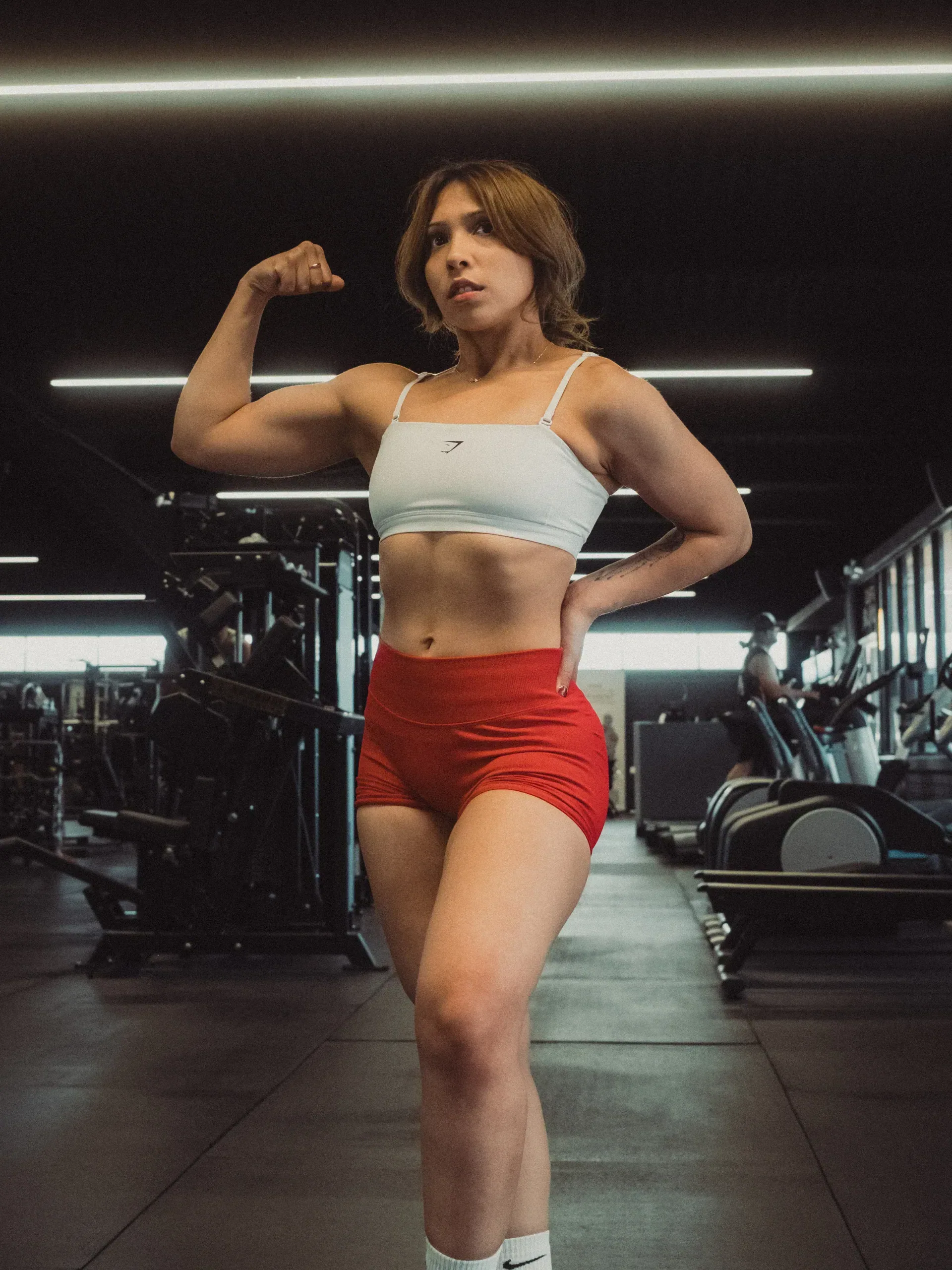
Where the Bulky Myth Came From, and Why Physiology Kills It
The fear is specific: that lifting heavy will produce a bulky, masculine physique by accident. It is worth taking seriously long enough to dismantle properly, because vague reassurance does not change behavior.
The hormone math
Testosterone is the primary driver of the extreme muscle mass that people picture when they say bulky. Women produce roughly a fifteenth to a twentieth of the circulating testosterone that men do. That is not a small difference at the margins. It is a different order of magnitude, and it is the single reason the fear does not survive contact with physiology.
Building muscle is slow, deliberate, and difficult even for men with every hormonal advantage. The idea that it might happen to a woman by accident, as a side effect of a few months of squats, gets the difficulty of the process exactly backwards.
What the women you are picturing actually do
When someone says they do not want to look like a female bodybuilder, they are usually picturing a competitor at the extreme end of a physique sport. Those athletes represent years, often a decade or more, of relentless training, meticulously engineered nutrition, and in the professional ranks, frequently pharmacology.
That physique is a destination people spend a decade driving toward on purpose. Nobody arrives there by accident on a four-day program. You are no more likely to wake up as a professional bodybuilder than you are to wake up as a professional cyclist because you bought a bike.
Toning is a marketing word, not a physiological process
There is no separate process called toning. What people mean when they say it is: build some muscle, lose some fat, so the muscle becomes visible. That is it. That is the entire mechanism.
And the tool that builds muscle is progressive resistance, meaning meaningful load, taken close to failure, with the weight going up over time. Three-pound dumbbells for twenty-five reps do not provide the stimulus. The toned look everyone is chasing is literally produced by the training people are being warned away from.
What Actually Happens When Women Train Heavy
Strength and muscle gains track men’s closely
Measured as a percentage of starting strength, women’s gains from resistance training are broadly comparable to men’s. Absolute numbers differ, because a larger person with more muscle and more testosterone will move more weight. But the rate of improvement and the capacity to gain muscle relative to your own starting point are far more similar between the sexes than gym folklore suggests.
Translated: the same principles apply to you. Progressive overload, hard sets, full range of motion, adequate protein, real recovery. There is no separate women’s physiology that requires a separate, gentler methodology.
Your body composition changes even when the scale does not
This one derails more women than any other, so prepare for it in advance.
You will be adding muscle while losing fat, especially in your first year. Those two changes can offset each other on the scale for weeks or months at a time. Meanwhile your waist measurement drops, your arms and shoulders take shape, your clothes fit differently, and your squat goes from an empty bar to 135 pounds.
If the scale is your only measurement, you will conclude that a wildly successful training block failed. Track measurements, progress photos in consistent lighting, and most importantly the weights in your log. Those three tell the truth. The scale tells one small part of it badly.
Bone density: the benefit nobody puts on a poster
Resistance training is one of the most effective interventions available for building and preserving bone mineral density, and it is meaningfully more effective than cardio for that purpose. Loading bone through muscular tension is what signals it to stay dense.
This matters enormously for women, who face substantially higher lifetime risk of osteoporosis than men. Every heavy set you perform in your twenties, thirties, and forties is a deposit in an account you will be drawing on in your seventies. Very little else in a gym has that kind of long-term return, and it is the single most under-marketed reason for women to train heavy.
Strength changes how you move through the world
The least measurable benefit is the one members mention most. Carrying every grocery bag in one trip. Moving your own furniture. Handling a suitcase into an overhead bin without scanning the aisle for help. Walking into a room with different posture.
Strength is not a look. It is a category of self-reliance, and it transfers to everything.
Where Women Have Genuine Training Advantages
Better fatigue resistance and volume tolerance
Women tend to demonstrate greater resistance to fatigue during repeated efforts, associated in part with muscle fiber composition and blood flow characteristics. Practically, that means many women can handle more total work per session and recover well from it.
If you can complete more quality sets before performance degrades, you can accumulate more of the stimulus that drives growth. That is a real advantage, not a consolation.
Faster recovery between sets
Related and immediately useful: many women recover more quickly between hard sets than men training at comparable relative intensities. Shorter rest periods on the same quality of work means more done in the same hour.
Less ego, better technique, faster real progress
Coaches notice this constantly. Women new to lifting are generally far more willing to start lighter, learn the movement properly, and progress deliberately. Men new to lifting frequently load the bar to what their pride demands and spend two years reinforcing bad patterns, or get injured and stop.
Learning to hinge correctly before adding load is not caution. It is the fastest available route to a heavy deadlift.
Your First Eight Weeks: A Real Program
Here is a concrete starting structure. Three days per week, full body, built on the five patterns that cover human movement.
The five movement patterns
Every effective program is some arrangement of squat, hinge, push, pull, and carry. Master those and you have covered your whole body.
-
Squat. Goblet squat progressing to barbell back squat. Alternatives: leg press, hack squat.
-
Hinge. Romanian deadlift. Alternatives: hip thrust, back extension.
-
Push. Dumbbell bench press progressing to barbell bench. Alternatives: machine chest press, overhead press.
-
Pull. Seated cable row. Alternatives: lat pulldown, chest-supported row.
-
Carry and core. Farmer’s carry. Alternatives: plank, dead bug.
Weeks 1 and 2: buy the pattern, not the number
Three sessions per week. Each session: one exercise from each pattern, two sets of eight to twelve reps, stopping well short of failure. Loads should feel genuinely easy.
The entire goal of these two weeks is motor learning. You are teaching your nervous system what a hinge is, where your ribs should be during a press, how to brace. Resist the urge to add weight, and get a coach to watch your squat and deadlift at least once. Two sessions of technique coaching now will save you a year later.
Weeks 3 through 8: progressive overload
Now the weight starts moving. Three sets per pattern, eight to twelve reps, with the last set taken to a point where you have roughly two reps left in reserve.
The rule is simple: when you complete all three sets at the top of the rep range with solid technique, add weight next session. Five pounds on upper body movements, ten on lower body. Then work back up the rep range at the new load.
That is progressive overload. It is not complicated, and it is the entire engine of your results. Write down every set, every rep, every weight. The log is what makes the progression real instead of vague.
What to expect by week eight
Most women following this consistently will add substantial weight to every lift, notice visible change in the shoulders, glutes, and arms, and, this is the part that surprises people, find that the gym has stopped feeling like someone else’s building.
Eating to Support Strength, Not to Shrink Yourself
Protein first, and probably more than you are eating
Aim for roughly 1.6 to 2.2 grams of protein per kilogram of bodyweight per day. For a 150-pound woman, that is roughly 110 to 150 grams, considerably more than most women eat by default.
Spread it across three or four meals with 30 to 40 grams each. Prioritize complete sources: chicken, fish, lean beef, eggs, Greek yogurt, cottage cheese, whey. Protein is what your body builds the muscle out of, and it is also the most satiating macronutrient, which makes everything else easier.
Stop chronically under-eating
This is the most common nutritional error among women who lift, and it is the one that quietly stalls everything.
Years of diet culture have trained a lot of women to eat as little as possible. But muscle is built with a surplus of energy and raw material. Training hard on 1,200 calories does not produce a lean athletic physique. It produces fatigue, stalled lifts, poor recovery, disrupted hormones, and often bone loss rather than bone gain.
Eat enough to fuel the training you are doing. If your goal is fat loss, run a modest deficit while keeping protein and training intensity high. If your goal is building strength and shape, eat at or slightly above maintenance and let the training do its work. Either way, aggressive restriction is the enemy of the outcome you want.
The micronutrients that matter here
Iron deficiency is meaningfully more common in women than men and shows up as exactly what you would expect: fatigue, poor endurance, flat training. Calcium and vitamin D support the bone adaptations you are working for. If your energy is persistently poor despite decent sleep and food, that is a conversation with your physician and a blood panel, not a supplement guess.
Walking Into a Serious Gym Without Feeling Like an Outsider
Let’s address the real barrier honestly, because it is not physiological. It is the walk from the door to the squat rack.
Most women who hesitate to train heavy are not confused about the science. They are anticipating being watched, judged, or condescended to. That anticipation is not irrational. Plenty of gyms have earned it.
A few things worth knowing. First, the people who look most intimidating in a serious gym are almost universally the least judgmental. They remember being new, and they are far more focused on their own working set than on you. Second, the fastest way to dissolve the feeling is competence, and competence comes from coaching. Two or three sessions with a qualified coach to build your squat, hinge, and press turns the equipment from a test into a tool. Third, the environment genuinely matters. A room with space, functioning equipment, and a culture of mutual respect feels completely different from a crowded floor where you are waiting on a bench while someone films a set.
Within a few weeks the intimidation stops being the story. You stop thinking about who is watching and start thinking about whether you are getting 95 pounds for eight this week. That shift is the whole thing.
Practical Takeaways
-
You cannot accidentally build a bulky physique. The hormonal math makes it essentially impossible.
-
Toning is just building muscle and losing fat, and it requires meaningful load.
-
Train three days per week to start, covering squat, hinge, push, pull, and carry.
-
Spend two weeks learning technique before chasing load, ideally with a coach watching.
-
Then add weight whenever you complete all sets at the top of your rep range.
-
Log every session. The log is what makes progression real.
-
Track measurements, photos, and your lifts. Do not let the scale be your only metric.
-
Eat 1.6 to 2.2 grams of protein per kilogram daily, spread across three or four meals.
-
Stop under-eating. You cannot build a strong body on a starvation budget.
-
Remember the long game. Every heavy set is a deposit in your bone density account.
Train Where Strength Is the Standard
Athlos Iron Lair was built as a serious training environment, and that turns out to be exactly what most women want once they have experienced the alternative. Space to work, equipment that functions, and a floor where lifting heavy is simply what everyone is doing rather than something that draws attention.
The facility runs 17,500 square feet in Torrance, with plate-loaded and selectorized equipment from Arsenal, Hammer Strength, gym80, and Cybex, a full dumbbell range, Mega Mass RDL machines for direct posterior chain and glute work, and an outdoor Southern California training zone with sleds, tires, and battle ropes. Membership capacity is deliberately limited, which means the squat rack you planned your session around is generally available when you get there.
True 24-hour access Monday through Friday with app-based keyless entry means you can train around your actual schedule rather than fighting the 6:00 p.m. crowd. And the coaching on this floor means the technique work that accelerates everything is available from people who have built physiques at the highest level.
You do not need to be strong to start here. You need to decide to become strong.
Frequently Asked Questions
Will lifting heavy weights make me look bulky?
No. Women produce a fraction of the testosterone men do, roughly a fifteenth to a twentieth as much, which makes accidental extreme muscle gain physiologically implausible. Building substantial muscle is a slow, deliberate process that requires years of specific effort even under ideal hormonal conditions.
How heavy should I actually be lifting?
Heavy enough that the last two or three reps of your set are a genuine effort. If you could perform five more reps after finishing, the set was a warm-up. For most exercises this means working in the eight-to-twelve rep range with a load that makes rep ten hard.
How long until I see visible results?
Most women notice strength improvements within two to three weeks and visible changes in shape, particularly in the shoulders, glutes, and arms, by weeks six to eight. Meaningful physique change over the first year is substantial if training and nutrition stay consistent.
Should I train differently around my menstrual cycle?
The research here is genuinely mixed, and confident claims in either direction outrun the evidence. The practical approach: keep your program consistent, and autoregulate on days when you feel weaker by reducing load slightly while keeping the session. Some women find their strength varies noticeably across the cycle. Others notice nothing. Track your own data rather than following a rigid template.
Is strength training worthwhile during perimenopause and after menopause?
It becomes more valuable, not less. Declining estrogen accelerates bone density loss, and resistance training is among the most effective ways to defend against it while preserving muscle mass and metabolic health. Programming should be guided by a qualified coach, and any specific medical considerations belong with your physician.
Do I need cardio too?
Some, for cardiovascular health, but it should not be the centerpiece if your goal is shape and strength. Two or three moderate sessions per week, or work in the outdoor zone with sleds and ropes, complements lifting well without compromising recovery.
Strong is not a size. It is a decision, made three times a week, with the weight going up.
Ready to start? Here is exactly where to go next.
Book your free VIP Gym Experience
Compare membership options and pricing
Build your technique from day one with personal training
Call (424) 317-3131 or visit us at 22715 Hawthorne Blvd, Unit B, Torrance, CA 90505.
Fight for the person you know you are.