
Hammer Strength Equipment Gym Guide: Why Lifters Choose It
· John Manzano
A serious hypertrophy session is not defined by how many machines a gym owns. It is defined by whether each piece of equipment helps you load the target muscle, control the eccentric, and repeat high-quality work when fatigue sets in. That is where plate-loaded Hammer Strength training earns its reputation among serious lifters.
A Hammer Strength equipment gym gives lifters guided, plate-loaded machines that support stable positioning, focused resistance, and progressive overload without removing the intent or effort required to train hard.
For newer lifters, that structure can turn intimidation into confidence. For advanced athletes, it creates another precise tool for managing volume, stimulus, and recovery alongside free weights. The difference begins with understanding what these machines do and how their biomechanics shape each lift.
Schedule a free tour and see an elite Hammer Strength equipment gym at The Lair for yourself.
What Is a Hammer Strength Equipment Gym?
A Hammer Strength equipment gym is a serious training facility where Hammer Strength plate-loaded machines form the backbone of the strength floor. Instead of treating machines as secondary accessories, this type of gym uses them to deliver heavy, repeatable loading for pressing, rowing, squatting, and lower-body work. The result is a training environment built around intent: stable setups, meaningful resistance, and enough equipment variety to support progressive overload across a complete program.
Hammer Strength is a strength-equipment brand owned by Life Fitness. Its product line is known for plate-loaded machines that let the lifter select resistance by adding standard weight plates, then drive through a guided movement pattern. Life Fitness states that the brand has pioneered more than 30 patents and tests its products beyond ASTM and EN standards, and describes the Hammer Strength line as built around performance-focused plate-loaded and selectorized equipment.
The defining feature is how the equipment organizes force around the athlete. Hammer Strength pioneered patented isolated lateral biomechanics, allowing the two sides of the body to work independently while following a controlled path. That matters when one arm or leg is stronger than the other, because each side must contribute instead of allowing the dominant side to quietly compensate.
Plate-loaded versus selectorized machines
Plate-loaded and selectorized equipment both use a machine-guided path, yet they create different training experiences. With a plate-loaded machine, you load the sleeves yourself, making the jump from one working set to the next visible and deliberate while feeling how the resistance behaves through both phases. That setup suits lifters who want substantial loading and a tactile connection to each set.
Selectorized machines use an integrated weight stack and a pin to choose resistance. They are fast to adjust and useful when a lifter wants to change loads in small increments without handling plates. Neither system is automatically superior; a well-designed program can use selectorized machines for efficient accessory work and plate-loaded machines for stable, high-effort compound patterns.
In practice, a genuine Hammer Strength equipment gym weaves both approaches into a larger bodybuilding and strength-training system. Machines provide structure without making training passive. The lifter still has to brace, control range of motion, choose an appropriate RPE, and earn each progression. Want to see what a real Hammer Strength training floor feels like? Schedule a free tour and experience the equipment at The Lair before you commit.
Why Serious Lifters Choose Hammer Strength Machines for Hypertrophy
Serious lifters choose Hammer Strength machines for hypertrophy because they make it easier to direct hard work into the intended muscle, control the eccentric, and progress without letting unnecessary stabilization become the limiting factor. That does not make free weights irrelevant; it gives you another precise tool for accumulating high-quality volume when the target muscle should determine the set’s outcome.
A guided path reduces the coordination demands of the exercise, so instead of balancing the implement you can concentrate on setup, range of motion, bracing, and the contractile action of the target muscle. For bodybuilding work, that matters most when a set approaches technical failure. If the chest, back, delts, or legs are the limiting factor, reducing stabilizer involvement keeps the stimulus where you intended it.
More control through the full repetition
Hypertrophy is not created by moving a stack or a plate with no regard for execution. The lowering phase is an active part of the repetition. Plate-loaded Hammer Strength equipment lets the lifter control resistance during both the lifting and lowering phases, creating an opportunity for deliberate tempo and meaningful time under tension. A controlled eccentric keeps the target tissue loaded instead of letting momentum or a rushed reversal decide the set.
This is especially useful after heavier compound work, when systemic fatigue may be high but a muscle still needs focused volume. You can select a load that permits a stable path, use a repeatable range of motion, and push close to failure without turning every final repetition into a test of balance. The goal is to keep the resistance challenging while preserving the mechanics that make the set productive.
Symmetry, isolation, and staying close to failure
Hammer Strength’s isolated lateral biomechanics allow each side of the body to work through its own resistance path. That design can help expose strength discrepancies and prevent the dominant side from quietly taking over every repetition. It also gives experienced lifters a way to train pressing and pulling patterns with a more direct emphasis on muscular output. The patented isolated lateral approach supports symmetrical strength development on both sides of the body while the guided design minimizes the stabilizer demand associated with free weights.
Training to failure is a programming decision, not a requirement for every set. A systematic review found a significant hypertrophy effect for training to failure in resistance-trained individuals, while also concluding that failure is not strictly necessary for gaining size. The relevant question is whether the set can be taken sufficiently close to failure with sound technique and recoverable volume. Machines can make that choice more practical because the path remains consistent as the target muscle reaches its limit.
Ready to train with more precision? Explore the equipment at The Lair and see how a serious Hammer Strength equipment gym can support your next hypertrophy block.
Hammer Strength vs Free Weights: Where Each Wins
Neither tool is automatically superior. Hammer Strength machines and free weights solve different problems within a well-designed training week. Free weights demand more balance, coordination, and stabilizer engagement, while Hammer Strength equipment lets you direct more of your available effort toward a target muscle through a guided path. The strongest program uses that distinction deliberately rather than treating machines as a lesser substitute.
For most experienced lifters, the practical answer is to use free weights for highly technical compound patterns and Hammer Strength machines for targeted volume, fatigue management, and hard hypertrophy work. Choose the implement that best matches the adaptation you are pursuing, your current stability, and the quality of execution you can maintain.
The hormonal distinction deserves context. A larger acute growth hormone or testosterone response does not, by itself, decide which exercise belongs in your program. The quality of your progressive overload, proximity to failure, recovery, and long-term consistency matter more than chasing a short-lived spike. Free weights may have the edge for high systemic demand and stabilizer involvement, while Hammer Strength often wins when the limiting factor should be the target muscle rather than balance or bracing.
Progressive overload is also more than adding plates. It can mean more repetitions at the same load, a stronger range of motion, improved control, or a higher-quality set at the same RPE. Hammer Strength equipment makes those comparisons practical because the setup and resistance path are consistent. If repetitions and execution improve over time, the muscle is receiving a clearer progression signal.
Use free weights early when technical precision and full-body coordination are priorities, then Hammer Strength work when you want to accumulate demanding volume without letting fatigued stabilizers govern every repetition.
Key Hammer Strength Machines You Will Find at a Serious Gym
A serious Hammer Strength equipment gym should offer more than a recognizable logo and a few plate-loaded stations. The lineup should give lifters distinct ways to load the back, chest, shoulders, and lower body through stable, repeatable movement patterns. At Athlos Iron Lair, the top-tier Hammer Strength lineup supports the kind of focused execution that makes high-intensity bodybuilding productive, especially when you are trying to keep the target muscle under tension instead of losing position as fatigue rises.
Iso-Lateral Row
The iso-lateral row is a foundation for back development because it lets you drive the elbows through a supported, repeatable path without turning every heavy set into a test of lower-back endurance. Independent handles also make side-to-side output easier to assess, so you can notice whether one arm initiates the pull and adjust your setup without disguising an imbalance behind a single bar.
Iso-Lateral Incline Press
An iso-lateral incline press gives the upper chest and anterior deltoids a stable pressing platform while preserving the practical challenge of moving substantial external load. The independent arms encourage each side to contribute rather than allowing the stronger side to dominate a barbell repetition. That matters late in a hypertrophy session, when the goal is to accumulate demanding reps with a consistent bar path and enough control to keep the pecs working. It is also a useful complement to free-weight pressing, not a replacement for every pressing pattern.
Shoulder Press
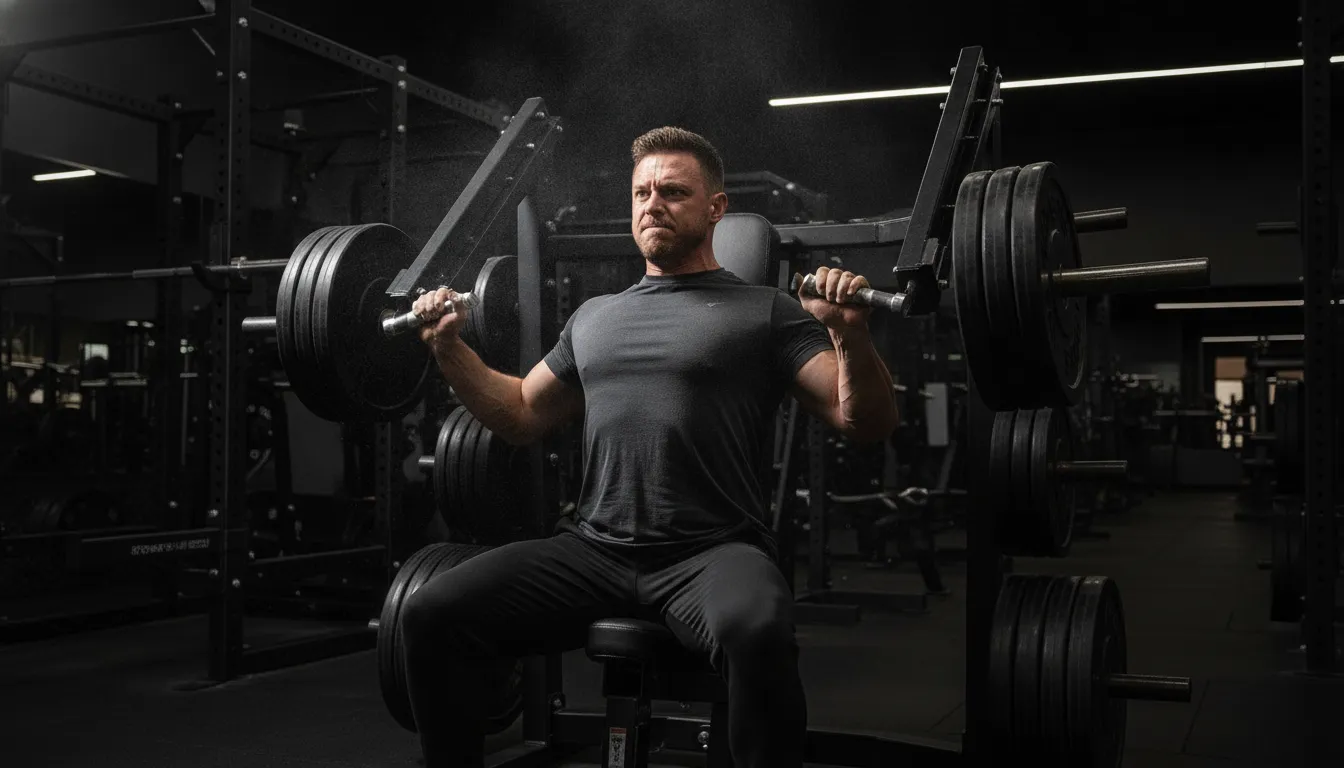
A plate-loaded shoulder press lets serious lifters train overhead strength and deltoid hypertrophy without spending every set managing balance and trajectory. With the seat, handles, and range of motion configured correctly, you can push close to technical failure while keeping the torso and shoulder more consistent. Add load when the prescribed reps remain clean, rather than chasing numbers that force compensation through the spine or upper traps.
Plate-Loaded Squat and Leg Press
The plate-loaded squat and leg press round out a serious lower-body lineup, letting you train the quadriceps, glutes, and adductors with heavy resistance while the equipment provides more external stability than a free-standing squat. Foot position, depth, and pelvic control still determine whether the movement is productive. Equipment does not replace technical discipline.
Athlos Iron Lair brings these tools together for lifters who want serious equipment, room to execute, and an environment built around real training. Review the equipment at The Lair.
Ready to train with equipment that matches your ambition? Schedule a free gym tour and experience the Hammer Strength lineup at Athlos Iron Lair.
How to Train on Plate-Loaded Equipment Without Getting Injured
Plate-loaded machines are not a substitute for sound technique, even when their guided paths make heavy training more stable. Treat each Hammer Strength movement as a controlled hypertrophy exercise: establish your position, load the machine symmetrically, own the eccentric, and progress only when your range of motion and execution remain consistent. Guided machine paths reduce the balance demands and injury exposure associated with free-weight lifting, which is one reason machines are also used in rehabilitation settings.
Set the seat and handles to your frame. Before loading plates, adjust the seat, back pad, starting position, and handles so the machine fits your limb lengths and intended line of pull. On a press, begin with the handles positioned so your shoulders are not forced into excessive extension. On a row, avoid reaching so far that your lumbar spine rounds or your shoulder capsule feels strained. Take a few unloaded repetitions to confirm the path feels stable and that you can achieve a useful range without pain.
Load both sides evenly. Plate-loaded equipment makes adding resistance straightforward, which supports progressive overload over time. Use matching plates on bilateral machines and check that each plate is fully seated. For independent iso-lateral arms, keep the loading intentional rather than making one side heavier because it feels stronger. Start with a conservative warm-up set, then add weight in small increments.
Control the eccentric and protect the joints. Do not let the machine pull you into the bottom position or allow the plates to crash between repetitions. Lower the resistance under control, maintain contact with the pad where the exercise requires it, and pause briefly when a hard reversal would otherwise turn into momentum. Controlled resistance lets the target musculature work during both the lifting and lowering phases. Stop the set if you feel sharp pain, numbness, instability, or a joint sensation that does not resemble ordinary muscular fatigue.
Train close to failure with judgment. Experienced lifters can take machine sets close to technical failure because the guided path reduces some stabilization demands, but the standard remains repeatable execution. Reserve true failure for movements and sets where you can safely exit the machine. Research indicates that failure is not strictly required for strength or hypertrophy, although it may benefit hypertrophy in resistance-trained lifters, so use proximity to failure as a programming variable rather than an excuse to sacrifice position.
Log the overload, not just the weight. Record the machine, plate load, repetitions, range of motion, and RIR or RPE. Progress may mean adding a plate, completing an additional repetition, improving control, or achieving the same workload with less joint irritation. If technique regresses, hold the load steady until you can own every phase again. For individualized setup and progression, personal training can turn serious equipment into a sustainable program.
Why Athlos Iron Lair Is the South Bay’s Hammer Strength Destination
A serious Hammer Strength equipment gym needs more than a recognizable machine lineup. It needs the space, training culture, and availability that let lifters use plate-loaded equipment with intent. Athlos Iron Lair brings those elements together in Torrance, giving South Bay athletes a premium environment for hypertrophy, strength development, and long-term body transformation.
The facility spans 17,500 square feet, so training does not feel compressed into a narrow room where every productive movement requires a wait. That matters when your session depends on an incline press, iso-lateral row, or heavy lower-body machine being available when your program calls for it. An uncrowded floor lets you build into working sets, manage RPE, and pursue progressive overload without constantly abandoning the plan.
Equipment built for focused training
Hammer Strength machines give lifters a stable, repeatable path while preserving the loading demands that make plate-loaded work so effective. That combination is especially useful after free-weight compounds, when the target musculature needs more high-quality volume without letting fatigue turn every set into a balance exercise. The result is a training environment where machine work is not an afterthought but part of a deliberate bodybuilding and strength system.
Explore the equipment at The Lair to see how the facility’s selection supports pressing, rowing, squatting, and lower-body specialization. The goal is not to collect equipment for appearance but to give members the tools to train hard and track performance.
A serious community without the intimidation barrier
Athlos Iron Lair attracts bodybuilders, powerlifters, strength athletes, and professionals who want training to be a meaningful part of their lives. That creates an atmosphere where real effort is normal. You will see advanced lifters working through demanding sessions, yet the standard is not exclusion. Someone who is still learning technique can train around serious athletes, ask better questions, and build confidence through consistent practice.
This is the difference between being intimidated by high-level training and being inspired by it. The environment gives ambitious members a reference point for what focused work looks like while the space keeps the experience personal rather than chaotic. For more local context, read about Athlos as a South Bay bodybuilding destination.
Ready to train where serious equipment and serious community meet? Schedule a free gym tour and experience Athlos Iron Lair yourself.
The facility also includes an outdoor Southern California training area with sleds, tires, and battle ropes, giving members another setting for conditioning and loaded movement without diluting the core bodybuilding focus. Whether you seek a stronger total, a more complete physique, or a training home that raises your standards, Athlos is worth seeing in person. Visit the blog for more training guidance.
Ready to put it to work? Schedule a free tour or talk with personal training about your next block.
Frequently Asked Questions
What is Hammer Strength gym equipment?
Hammer Strength is a line of plate-loaded and selectorized resistance machines designed around guided, often independent movement paths. The independent arms can help each side contribute evenly, while the supported setup lets you focus on the target muscle instead of managing balance.
Are Hammer Strength machines any good for hypertrophy?
Yes, especially when they solve a specific programming need. A Hammer Strength press, row, or lower-body machine can provide stable loading, repeatable range of motion, and a practical way to progress resistance while keeping the target tissue under tension. Use them alongside free weights.
Why do bodybuilders prefer Hammer Strength machines?
Bodybuilders often value the combination of heavy loading and targeted isolation. The guided path reduces the stabilizer demand compared with free weights, which can make it easier to push a muscle close to technical failure without having balance or coordination end the set first. Failure is not mandatory for growth, although research has found it may benefit hypertrophy in resistance-trained lifters.
Are Hammer Strength machines better than free weights?
Neither is universally better. Free weights demand more stabilization and develop skill with unconstrained movement, while machines offer more support and precise emphasis on a target muscle. A serious hypertrophy program can use barbells and dumbbells for foundational strength, then Hammer Strength equipment for controlled volume, weak-point work, and hard finishing sets.
How should I choose a Hammer Strength machine?
Choose the machine that matches your training objective, body proportions, and available range of motion. Adjust the seat, handles, and start position before loading plates, then use a controlled eccentric and stop when technique degrades. If the setup feels unfamiliar, ask a qualified coach to check your position and execution.
Ready to Train on Hammer Strength Equipment?
The right equipment makes progressive overload more deliberate, especially when you want a controlled path and consistent execution across hard hypertrophy sets. A free gym tour gives you a practical look at the training environment and equipment selection. Book your free gym tour through membership options. Walk in with questions, see the machines in person, and take the next step toward focused training.